

Lorem ipsum dolor sit amet, consectetur adipiscing elit. Maecenas a fringilla tortor, et porttitor tort. Vestibulum non nisi interdum, blandit dolor in. laoreet magna. Suspendisse sit amet elit sit amet nisl. semper imperdiet. Suspendisse
When I was CMO at an early-stage startup, my CEO asked me to prepare slides for an upcoming board meeting. I did what I thought was right: I packed them with every marketing metric I could find.
Looking back, I didn't really know what made a good board deck. I don't remember ever taking a course on how to build one, and I suspect most GTM leaders -- and even many founders -- haven't either.
One of the benefits of working in venture is getting to see how dozens of companies approach the same challenges. Board decks are a great example. Every quarter, founders and GTM leaders wrestle with the same questions: What belongs in the deck? How much detail is too much? What does the board need to understand?
Over time, I've come to appreciate that a good board deck isn't about reporting everything the business has done. It's about telling a coherent story: where the company is performing well, where it's falling short, what's changing, and what the management team is doing about it.
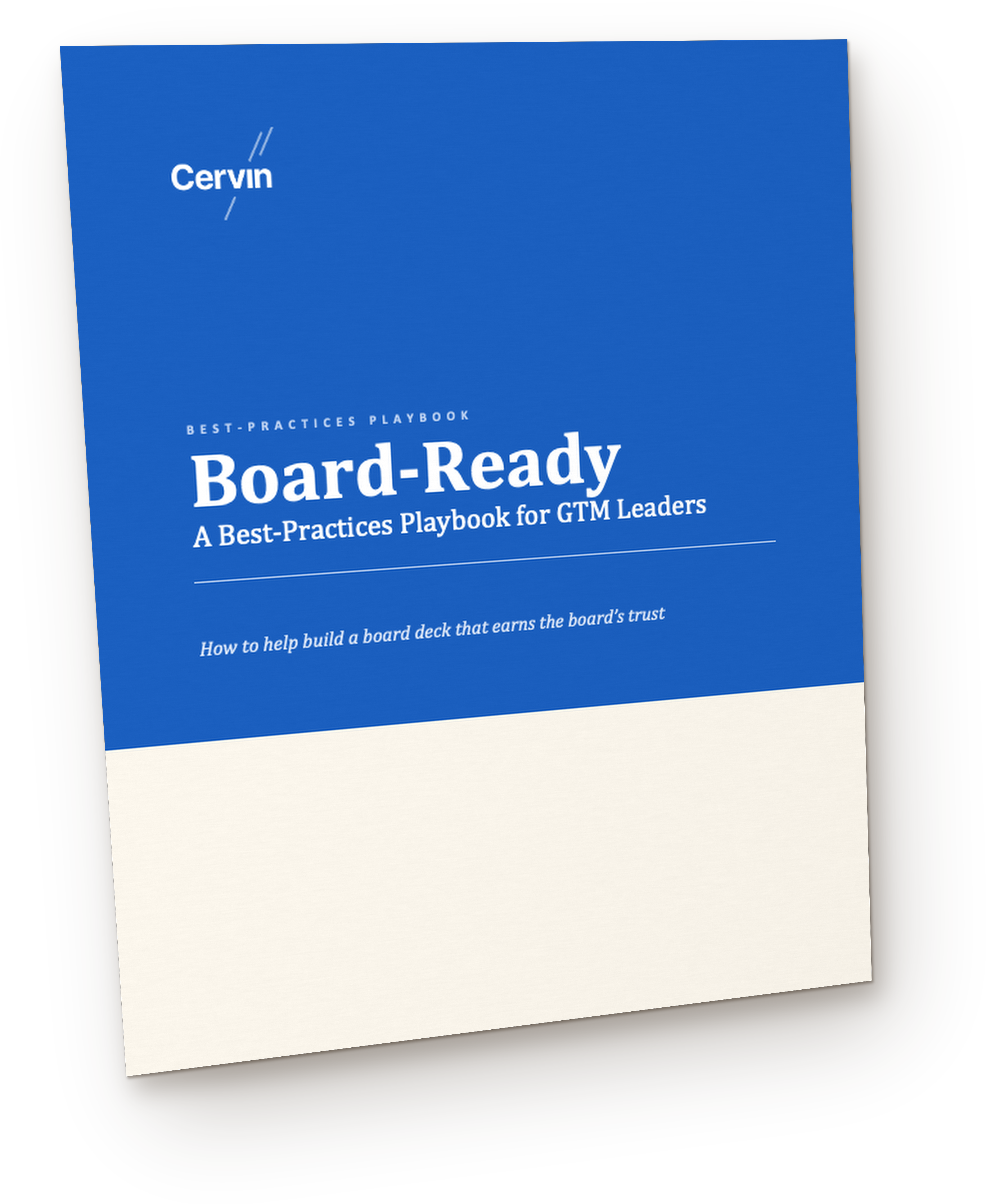
That's why I put together Board-Ready: A Best-Practices Playbook for GTM Leaders. It's a practical guide to helping GTM leaders build better slides and, more importantly, contribute to a board deck that tells one company-wide story.
The idea started when Pavilion invited me to contribute to its Preparing for a Board Meeting guide.
The real catalyst came later, when we developed an automated process to analyze board decks. After reviewing more than 100 decks from 30+ startups, ranging from Pre-Seed through Series D, and comparing observations with other VCs, I saw the same four issues surface repeatedly:
1) Too much data, not enough context: Slides were packed with metrics but offered little explanation of what was driving them or why they mattered.
2) Inconsistent reporting: The same metrics had different values across slides, or Finance and GTM were working from different numbers.
3) Missing or changing metrics: Standard metrics disappeared from one quarter to the next, or their definitions changed without explanation.
4) Unclear asks: Management teams presented challenges but didn't articulate where they needed the board's help.
These aren't really slide-design problems. They're symptoms of a larger challenge: getting the management team aligned on the business story and translating that into a meaningful board conversation.
GTM leaders have an important role to play in solving this. Here are three practices I'd recommend adopting before your next board meeting.
1. Explain what changed, and why.
Every board deck has data. Far fewer explain what's driving it.
"New business bookings were down 12% this quarter" is a data point. A board-ready explanation goes further: Where was the decline concentrated? Which stage of the funnel was affected? Was it a pipeline-generation issue, lower conversion, longer sales cycles, or something else? What does management believe caused it, and what is the team doing about it?
For every important metric, be prepared to answer two questions: So what? Now what?
The goal isn't to explain every fluctuation or fill the slides with commentary. It's to give the board enough context to understand what matters, what management is learning, and where the team is focused.
2. Tell one company-wide story.
One of the most common problems I see is a board deck that reads like a collection of departmental updates. Sales presents its pipeline, Marketing presents its campaign numbers, Product presents its roadmap, and Customer Success presents customer metrics. Each section might be accurate, but the connections – and the story – between them are often missing.
Sustainable growth doesn’t come from a single functional silo. Pipeline generation, sales productivity, conversion, retention, and customer outcomes are interconnected. The board should be able to see how these pieces are working together to deliver the company's revenue goals.
To that end, GTM leaders should offer to review the deck before it goes out and help make sure all the metrics and topics ladder up to the goals your CEO has for the meeting. Are you using the same definitions? Do the numbers reconcile? Does the story connect activity to business outcomes? Are there gaps or conflicting theories on what’s going on that need to be resolved?
And remember: not every quarter requires an update on everything. If a particular function isn't central to the company's priorities, resist the temptation to add slides just to get more time in front of the board.
3. Know your numbers, and keep them consistent.
A good board presentation doesn't end when the slides are finished. The real test comes when directors start asking questions.
Leaders need to understand their metrics well enough to take the conversation beyond what's on the page. That doesn't mean having an answer to every question. It means knowing what drives the numbers, understanding their limitations, and being prepared to explore what they mean.
Start by identifying 8–12 keystone metrics that matter most to your business and reporting them consistently every quarter. Define each metric once, reconcile the numbers with Finance before the deck goes out, and clearly flag any changes in definitions or gaps in reporting.
Avoid data dumps, constantly changing templates, or bad news that you’re introducing in the board meeting. Consistency in reporting makes it possible for the board to see trends. Transparency on what the numbers mean and where they came from builds trust. The context you provide in your commentary is what makes the numbers meaningful.
And if you can’t report on a particular metric on quarter, just call it out. A clearly explained gap is another data point for the board. An unexplained gap creates questions about what else might be missing.
A better board deck starts well before anyone opens PowerPoint. It requires the management team to agree on the company's priorities, understand the metrics, and communicate a consistent view of the business.
In short, that means:
• Know your company story.
• Know your numbers.
• Explain what changed, and why it changed.
• Show what you’re doing.
• Isolate issues for the board where you need their help.
Founders & CEOs: You own the overall board narrative, but you shouldn't have to build every slide yourself. Your leadership team should play an important role in making sure the company's revenue story is clear, consistent, and connected across functions.
GTM leaders: You don’t have to stop at simply reporting on your function. Help your CEO and the rest of the management team craft a deck that helps you engage the board and get their help. and what needs to happen next.
That's the thinking behind Board-Ready: A Best-Practices Playbook for GTM Leaders. It provides practical guidance for building stronger GTM slides and helping the entire management team prepare for a more productive board conversation.
Download the playbook: Board-Ready: A Best-Practices Playbook for GTM Leaders



We'll send you a nice letter
once per quarter. No spam.

© 2025 Cervin / All rights reserved.